
Northwest Ohio Teen Book Festival
Season 27 Episode 22 | 27m 37sVideo has Closed Captions
Northwest Ohio Teen Book Festival April 25, 2026
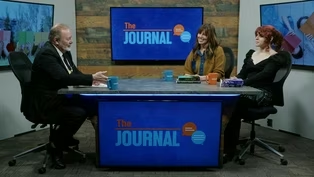
The Northwest Ohio Teen Book Festival is an event that allows Northwest Ohio teens to meet their favorite authors and discover new authors.
Problems playing video? | Closed Captioning Feedback
Problems playing video? | Closed Captioning Feedback
The Journal is a local public television program presented by WBGU-PBS
Northwest Ohio Teen Book Festival
Season 27 Episode 22 | 27m 37sVideo has Closed Captions
The Northwest Ohio Teen Book Festival is an event that allows Northwest Ohio teens to meet their favorite authors and discover new authors.
Problems playing video? | Closed Captioning Feedback
How to Watch The Journal
The Journal is available to stream on pbs.org and the free PBS App, available on iPhone, Apple TV, Android TV, Android smartphones, Amazon Fire TV, Amazon Fire Tablet, Roku, Samsung Smart TV, and Vizio.
Providing Support for PBS.org
Learn Moreabout PBS online sponsorship(upbeat music) (graphic pops) (upbeat music continues) - Hello and welcome to Journal.
I'm Steve Kendall.
The Northwest Ohio Teen Book Festival is a volunteer organization that creates an event that allows northwest Ohio teens to meet their favorite authors, and discover new authors.
We wanna welcome The Journal, Denise Phillips, who's the co-founder of the festival.
- Thank you.
- [Steve] Thanks for being here, Denise.
- Thank you.
- Kinda give us a background.
How long have you been doing this, and kind of take us through the evolution of things you've learned along the way, and then we'll start talking about what's going to happen in April.
- Yeah, absolutely.
So this'll be our fifth actual festival.
The 2026 is is our fifth, so we're super excited to celebrate our fifth anniversary.
However, we actually started planning the festival in 2019, and our original first festival was supposed to be the first weekend in April of 2020.
- [Steve] Ah, and we know what happened there.
- We all know what happened, right?
So we've been working on it for many more years than we've actually been having festivals, but we're really excited that this is festival number five.
And it's grown every year, and it's gotten more exciting every year.
And this year we have a venue change as well.
So for the past four years, Rossford Junior Senior High has hosted us.
It's a fabulous building, it's gorgeous.
This year, it's gonna be at the Toledo School for the Arts in Toledo.
So we're kind of venturing into a slightly new location, but we think it's gonna be a great, a great move with a little simpler layout for the attendees to be able to find where they're headed.
- [Steve] Yeah, and I noticed when I looked online and all the different places, you've got easy location, how you can get there, good direction.
So it's no problem finding the location.
- Yeah, no problem, and lots of parking, so no worries about that.
- [Steve] Yeah, that's always an important thing.
Talk a little about, now, when you initially started this, the first event that you were planning, have you changed the way you do things?
Compared that, I mean, obviously you learned what worked and what didn't, or what maybe the students or teens were more interested in than things maybe you thought the first time around?
- [Denise] Yeah, absolutely.
So every year, we tweak things a bit based on the previous years.
We do have a survey at the end that if the students or the participants choose to, they can respond and kinda tell us what worked, what didn't work.
One of the things we often got feedback on was I couldn't figure out where I was going, right?
So that was part of the, every year we were trying to make it simpler and simpler to find how to get to the sessions you wanted to get to.
So, yeah, absolutely.
Every year it gets tweaked, and every year there's a session that, at least for me, that I think is just gonna be the most popular session.
And I'm always shocked that I'm like, well, I totally did not know what I was talking about, so.
- [Steve] Once you figure out how teens think, let us know how that works.
I'll be good on that because yeah, once you have that nailed, everything else will fall in place.
So when you look at like, this year's group of people, you have folks, you guys sit down and say, okay, here's who we think we want to come, here's who we think we want, topics we wanna do.
Kinda take us a little bit through that process.
Do you always, how long does it take to get to the point of saying, oh, here's what we're going to do.
- So most of the planning period is getting authors on board and getting the programming.
And we just released the programming.
So we're finally there.
So we're finally at the part where we can start being like excited and telling everybody about it, rather than trying to figure out how to make everything work, right?
How to make sure everybody gets a break to eat.
How to make sure everybody's in the sessions that they are most interested in being part of, and most interested in con contributing to.
So that's always a great, like, sigh of relief.
Like, okay, we're there.
Now we can just start spreading the word.
So, yeah, but Amanda from Bowling Green State University was very integral, did I say that word right?
- [Steve] Yeah, integral?
- [Denise] Integral.
- [Steve] Integral, yeah.
- [Denise] To making sure we have not only a great lineup of authors with a diverse selection of genres, backgrounds, topics to discuss, and then also the programming, and making sure each author is in the correct number of sessions and actually interested in what we've asked them to speak about, so yeah.
- [Steve] Now it says Northwest Ohio Teen Book Festival.
I know that when we've talked to you folks in the past.
People come from outside of Northwest Ohio.
So talk about the reach that you have now with this, because now the last time, you talked about people coming from several hundred miles away to attend.
- Yeah, one of the great things, and this has been since day one, is we've always worked to break down any barrier to anybody attending who wants to attend.
And part of that is we provide bus sponsorships for schools.
So if a school wants to get a group of kids together to come to the festival, we will figure out a way to fundraise to cover the cost of that bus getting here.
And that makes it so that places and teachers, and students that may have felt like they couldn't get to northwest Ohio can do so, and so that helps a lot.
We also have some folks that come down from Michigan, which is great.
So we maybe should think about changing the name from Northwest Ohio to something more inclusive.
But it's worked for us, and yeah.
So it's always fun to find some new attendees, and figure out how far they're coming and where they're coming from.
- Yeah, and you mentioned fundraising.
Talk a little about that, because obviously, there are costs involved here.
- [Denise] There are.
- So talk a little about how that, and how you go about getting funding, and what that funding goes to.
Obviously to bring authors to do all the logistical things that take place with the venue, that sort of thing.
- Yes, so fortunately, publishers and authors are quite generous with us, but we do have the bus sponsorships is probably our biggest expense, aside from we do have a hotel expense for the authors to stay in town.
But yeah, we start fundraising the day after we finished the previous year's festival.
And so between, there's about six of us on the committee and we all have our connections within the community.
And so we all come up with creative ways to fundraise.
So we try to raise about $10,000 a year to cover the cost of the festival, which we feel like we're being pretty frugal.
- [Steve] Sure, oh yeah.
- And we feel like we're doing it pretty well with a smaller budget, but it definitely is a lot of us trying to convince people it's a worthwhile venture to contribute to.
- [Steve] Sure, yeah, I mean, when you mentioned $10,000, you look at what you're going to present, that seems almost, I mean, that's incredibly efficient.
- [Denise] It feels like we're being very frugal, yes.
- [Steve] Very incredibly efficient.
We've got a couple of moments here in this segment.
So kind of step us through kind of the general thing that, because it's a one day event, starts at nine o'clock, runs through 3:30, three o'clock, that sort of thing.
So somebody's gonna attend, what will be their sort of list of events that day, things they can take part in?
- Yeah, so what, like you mentioned learning as we go along.
So one of the things we learn, like I said, is that it can be challenging for people to navigate through the festival.
We do offer, we have four breakout sessions, and we offer about seven options per session.
So there, you know, it does take up a pretty big footprint.
So one of the things we learned is we open the doors early and we start with kind of a scavenger hunt-ish, escape room-ish kind of event.
And that helps people get around the building.
- [Steve] Figure out the lay of the land.
- And see where the different rooms are.
So we open with that, and it's a lot of fun.
The students have a really good time getting their stamps and finding all the locations.
And then of course, they turn it in and we give away books by the authors at the opening session.
And then we start with a welcome and a keynote.
So this year's keynote author is Susan Dennard, who wrote the "Witch Lands" series, the "Luminaries Trilogy," and her newest book is called "Executioners Three."
Very good, excellent author, New York Times bestselling author.
And so we open with a keynote, the welcome and the keynote, and then we move into the breakout sessions.
And we have four breakout sessions, as I mentioned, with seven options.
And we kinda break those into compartments for, we have panel discussions with the authors.
We have artist workshops.
So we have really fantastic artists who do graphic novels and illustrations for picture books.
And they run sessions where the kids can learn how to create a character, or how to create expression.
And we have writers' workshops for students who are interested in writing their own book.
And we have some fun stuff too, like a board game room, where you can go play board games with the authors.
So we do a lot of interactive stuff as well as the panel discussions, where it's more learning by listening.
- [Steve] Yeah, and we're gonna talk to a couple of the authors that are gonna be here, and some of your other partners, too.
So yeah, well, thank you so much.
We appreciate you doing this, and always good to have you guys on.
And again, it looks like another great event coming up in April, but we're gonna be talking to more of the folks, some of the live, because you have partners in the library business that are involved in this, and a couple of the authors later in the show.
So, thank you so much.
- [Denise] Fantastic.
Well, thank you, yeah.
- Yep, we'll be back in just a moment with more about the Northwest Ohio Teen Book Festival here on The Journal, back in just a moment.
Thank you for staying with us on The Journal.
Our guests are from the Northwest Ohio Teen Book Festival, and we're joined in this segment by Maria Simon and Nicole Skilliter.
Maria, you're from the Wood County District Public Library.
Nicole from Bowling Green State University's Jerome Library.
Maria, talk about, first of all, you're the public children's place head librarian.
So tell us what that means at the Wood County Public Library, the Children's Place.
- Well, it's we actually serve children from birth all the way through their young adulthood.
So yeah, we're really, really lucky.
We have a wonderful space for everyone, and we have a specific collection for young adult literature.
- [Steve] Yeah, okay, and that sort of ties.
- [Maria] It's important.
- [Steve] And ties directly into the book festival.
- [Maria] Yes, yes.
- And Nicole, your role at the curriculum at the Jerome Library.
- [Nicole] Yeah, we serve pre-service teachers, as well as any of our community members that wanna come and enjoy the resources we have at the library.
So we have not only teaching aids, we have books K through 12, as well as young adult books too, of course.
- [Steve] Yeah, so it makes sense for both of you to be involved in this.
Yeah, it puts out perfectly.
Talk about the involvement of the library, the Wood County District Public Library in this event.
And you've been involved in the past.
Kind of take us through your involvement.
- [Maria] As professionals, we like to go to these things too.
I mean, the young students, I mean, the teens, they want to go, it's for them.
But we also really enjoy going because we wanna meet the authors.
We also wanna see the readers.
So it's a really nice way to build community.
So we support and encourage kids to go.
We also look at their list that the committee has put together, the authors, and we wanna buy those books, because we know that when those kids go and meet these authors, they're gonna want to read more of their books.
And they have quite a list of authors that are coming this year.
And so it's extremely impressive.
And there's a lot of 'em, and a lot of 'em have written a lot of books.
So it's an opportunity for us to use that list to purchase.
And so that's really important.
Yeah, I guess it makes sense too, because that way you have insight into what you want to have available at each of your locations.
- [Maria] Right, well, our readers are gonna demand it, so, right.
- [Steve] Gonna come in and say, "Why don't you have this book?"
That way you're, yeah.
- [Maria] Right.
(chuckling) - [Steve] Good, and Nicole, talk about your role in this too, and the curriculum center, and how that ties into what you do as well.
- [Nicole] Yeah, so it's my first year involved in the program, which is really exciting.
I was an attendee in the past, and we really not only support student teachers in trying to find quality resources and literature examples for their students that might fit this age group that is going to the event.
So that's a really exciting part, is trying to get not only good quality resources, which we have, but trying to kinda connect them in the community of literature, but also the exciting part of actually interacting with students with those books.
- Yeah, and one of the things I think that's interesting now, this just doesn't focus on English or language arts.
You get students from, of course, all the different, the festival tracks people who are interested maybe in history, because obviously there's writing involved there, is the creation involved in that.
When you go to the event, is there anything you ever see that, like, surprises you, like, oh, we didn't know that they'd be, that didn't see that coming in terms of, wow, they're really interested in that.
At least we didn't see that.
- [Maria] You mean the the readers or the, well, always, because I mean, what you're exposed to when you meet creative people is always exciting.
And when you meet an author who's published, and you realize not only do they have really interesting ideas, but they also get the job done.
They've gotten published, they know how to finish the work, and to then promote it.
And so a lot of what they're doing is promoting it by coming to the festival, also by meeting, a lot of readers will, young readers will meet authors and then get attached to them.
And especially when you meet them in person, it's a really dynamic.
I have actually a really fun story.
My colleague, Cassie, was at a book signing once years ago and met Claire, the one of the... - [Steve] Gonna be on in the next segment.
- Yes, yes.
She, and Claire probably doesn't even know this, so she met Claire in the line and became friends, and then became friends on social media.
And now Claire is a published author.
So Cassie will connect with her then at the festival.
And, but it's all that community building that the teens will meet each other, and so it's really, really exciting for them to like, find another author to read, but also find another friend who they can like, read with, or interact with around literature, so.
- [Steve] Yeah, because that's, I guess that's one of the advantages too of this is we've talked about with Denise, that it brings students and teens in from all over the region and they find out, oh, you're interested in this too.
Or they find that they're, someone mentions to them a different author that they weren't aware of, or weren't maybe thinking they were interested in, and now they're connected.
- [Maria] Someday in the future, they become an author.
- [Steve] Yeah, yeah, and that's the thing.
- Or a librarian.
- [Steve] Yeah, and one of the things, and when we talk to the folks who we're gonna have on the next segment is that whole creative process is amazing to a lot of people because a lot of everybody thinks, oh, I can sit down, I can write a book, I can whatever, whatever the creative part is.
And it's not that simple.
It's a lot of work and it's a lot of thought and a lot of effort goes into creating something that other people will be interested in reading or looking at or whatever.
- Right, so they have a lot of experience to share with young people.
And they're writing stories that young people really need.
And that's really, really important.
And so to meet these people and to be able to connect with them, and then connect with what they've written in the past, but also what they're gonna continue to write.
And these authors have a lot of stories, so they've published what they've published, but they also have so much more to share because they're idea generators, and yeah.
So they're interesting people to meet and to connect with in the panels.
- Yeah, and Nicole, from the library's point of view at BGSU, you talked about providing all of these resources.
How do you go about making sure that you have the resources that people need, and that when they come in, you have what's available to them that they're looking for?
- [Nicole] Yeah, we use a lot of different sources.
So not only our students, but our faculty that recommend items to us, our community members that have that investment and wanna use those resources too.
But it's also just kind of taking note of the world around us, right?
Like, looking at what's popular right now, what's really kinda buzz words like that.
But we really enjoy not only looking at those, but just taking suggestions from the students that come in, or those pre-service teachers that are coming from the classrooms and saying, "My students are all reading this book right now "and they're excited about it.
"Can you order it for us?"
And we absolutely will.
- [Steve] Yeah, now, how fast does that turn over?
Like, is last year's buzzword or books, are those like, oh, nobody's paying attention to those, or does it turn over quickly or faster than it used to, maybe, or not?
- [Nicole] I think it can in some ways.
But I think they still all stay relevant in some sense, which is really nice.
And then there's something for everyone, which I really enjoy.
- [Steve] I mean, is there like a hot topic or a hot category?
A hot area that this year, or that you could say, oh, this is the one that people are most interested in this year compared to two years ago, that kinda thing?
What would that be?
Do you, off the top, I know I'm putting you on the spot here.
- Oh yeah.
- [Steve] Yeah, if somebody walked in and said, "Oh yeah, we've got that," yeah, so.
- I think anything fantasy right now is really popular.
Not only young adult, but of course adult novels too.
But especially, I really think about anything romance.
We like love, I don't know.
- [Steve] Okay, well, yeah, that's a good thing.
It's good that we're full, that's one of the better topics.
- [Nicole] Truly.
- [Steve] Well, great, well, thank you both for coming on, because this gives us an insight into what you guys gather from this and as I say, everything interacting and comes full circle so that you have things available that people are interested in.
They come to your facilities and you also are bringing what to this event, what the libraries can contribute as well.
So it's part of that big partnership that takes place at this event.
So, great, thank you so much for coming on.
- [Maria] Thank you.
- [Nicole] Thank you.
- We'll be back in just a moment with a couple of the authors that are gonna be at the Northwest Ohio Teen Book Festival here on The Journal.
Back in just a moment.
You're with us on The Journal, and we have guests on from the Northwest Ohio Teen Book Festival.
In this segment, we're joined by two of the authors who are gonna be there, who have written lots of books, and they're here to talk about how they go about that process, and to interact with the students that are gonna be at the book festival.
We're joined by Claire Winn and Andrea Hannah.
And Claire, talk about your process, how you got into what you do now, which is writing these books that appeal to millions of people.
So talk about how did you start?
What made you think, you know, I think I can write a book.
When did that hit you?
What age were you at when you said, "I think I'd like to be an author?"
- So it wasn't like, it didn't all hit me at once.
I've always really, I've been drawn to telling stories since I was little.
I was always making up stories in my head.
I really loved sci-fi and fantasy from a young age, like the Narnia books.
But it wasn't until I was a teenager and I started getting into video games like Legend of Zelda, Fire Emblem, and then teen sci-fi and fantasy like "Eragon," and Holly Black's books, that I started to think, you know, maybe I'm never going to outgrow this.
Maybe this is something that people do for their careers.
And I was too shy for the longest time to write any of my ideas down.
It seemed terrifying to me that these ideas in my head, once I put them to paper, I would realize that they weren't as cool as I'd been imagining.
And there was also the idea that like, if I write them down, someone might read them.
Someone might stumble upon this and read it, and it's terrifying.
So it took me until my senior year of college.
I was graduating from Northwestern with like, history and political science, and I still wasn't quite sure what I was doing with my life.
So I was like, on a whim, I took a writing course, and the rule was, you need to start at the very beginning of whatever we're critiquing so that we can critique from the start.
So I had to really start at the beginning and get this idea on paper, and it went from there, and I realized I really loved it.
I got great beta reader feedback.
And even though that book didn't ultimately get me an agent, these books did, they got me my first agent, my first publishing deal.
And I've really, I have fallen in love with being an author.
- [Steve] Yeah, and Andrea, how about you?
How did you get started in this process and said, oh, this is gonna be a career, I think.
- [Andrea] You know, nobody teaches you that it can be a career, right?
- Right, sure.
- So I loved storytelling, like most of us do when we are younger.
And then I went into teaching for a long time.
I was a teacher for 12 years, and I always wrote as well.
And then actually when I had my two kids very close at age, I was up all the time in the middle of the night, and I just started typing.
And I had a good writer friend who was also up in the middle of the night with an infant, and we started exchanging ideas, and then the rest is kinda history.
And then I sold a book and I was like, oh, you can do this.
I can like, yeah, and here we are now, yeah.
- [Steve] Well, you know, it's interesting too, Claire, when you were talking about the fact you're writing this, and of course, there is that step, because obviously to be an author, to be a musician, to be an actor or whatever it is, you have to put yourself out there.
And I know you said, you know, I wasn't sure if I want anybody to read this after I wrote it.
Maybe it's not that good.
But then you realize, oh, the only way to do is to put it out there and see what people think.
And that's probably, that was a huge step, I'm sure, because you're like, I'm gonna put this out there and take whatever comes from it.
And sometimes, not all of it's good, I'm sure, but most of the times.
But that was your first thing.
It's like, oh, I've gotta step out there and see, is this where I wanna go?
So when you we experienced the first results, what did that feel like when you were like, oh, people do kinda like this?
- [Claire] Yeah, so it was very affirming.
First was feedback, in the course I was taking both from the instructor and other people who were in the course.
And I was also, once I had a draft that was readable, I was sending it to a few of my very nerdy friends who love sci-fi and fantasy books.
And a few of them were like, you have to try to get this published.
It's so good.
And it, of course wasn't as good as they thought it was, because they were my friends, but, well, but it gets some attention from literary agents.
But that first foray into the publishing world gave me a lot of a good understanding of what the publishing process was like, what the market looked like, how to write an effective pitch, and how to basically structure a story around an effective pitch.
And that kind of informed the rest of my career going forward.
- [Steve] And Andrea, what about you?
When you made that first, oh, I've written this.
What are people gonna think of this?
What was that first step like?
- It's always scary, right?
Don't you think?
It is, and I don't know about you, you do grow a thicker skin as you go.
You have some wins, you have some successes, you build some confidence, and it matters less about the negative stuff and more about what if you feel like you've done your job when you've written the story.
But in the beginning, it is pretty heart-wrenching.
I think it's important to have the support of your friends, the community, other people to both show you your strengths and your weaknesses in a kind way.
- [Steve] Yeah, now do you, and each of you can answer this, do you think you write differently today than when you first started out, or do you still feel you have some of the themes or some of the pieces that you started out with?
What do you think, Claire?
- [Claire] I think that my voice has definitely, I've grown into my voice as an author, and it has definitely varied between books, like my first published series is young adult sci-fi.
My next books that are under contract that I can't talk about quite yet, are adult fantasy.
They're a dark fantasy.
So the tone varies.
The young adults books are a little bit faster paced, they're more voicey, they're more snappy dialogue.
But it does depend on what I write.
But it also, I have developed a little bit more of a sense of what readers are going to latch onto, what kind of details I can put in, the sense of subtlety that will pervade a story.
Like what a narration should focus on versus what should you gloss over, showing versus telling.
And that has been honed through like, reading great books and also getting a lot of feedback throughout the process.
- Yeah, now did you, you mentioned a couple of things, and what were, are there influences now that maybe you feel other authors or other areas that influence you now when you sit down to write?
Or do you have your own sense of who you are now completely?
- Yeah, I think I have a pretty good idea of what my voice is, but like, pretty much any good book or any good piece of media, I will try to take something away.
Like, oh, I was really invested in the climax of this book.
Why is that?
The author threaded all of these really interesting stakes and pieces of conflict and tension and brought them together at the end.
And like, how might I apply something like that in my own works?
So in a sense, I am always learning, but I think I have a pretty good idea of like, who I am and what I write at this point.
- [Steve] And Andrea, what about you too?
Do you think you write differently, radically differently now than you did when you first started, or?
- [Andrea] I think every single book is different.
You should grow each time, but I think each book always has an essence of me, what I'm interested in, what I care about, the social issues that matter to me.
And that essence of my voice stays the same, but the craft is better, the way that, like Claire was saying, the way you display it or you show that, you try to tell the story that you set out to tell.
And that comes just from experience and time, I think, yeah.
- Now if any, we've got like just a moment or two.
If there was one word or a few words you would tell that the teens that are gonna be at this book festival, what would you say?
If you wanna start, here's the first thing you should do, or the first thing you should try?
- Oh my gosh, community.
I really think, and this festival's fantastic for that.
Finding each other, finding other readers, finding other writers, have your support system, the people that can be your cheer readers, as we call them.
- [Steve] And what about you, Claire?
What would you say if they said, how do I, if someone walks up to you and says, "Okay, how do I start?"
What would you tell them the first thing they should do?
- [Claire] I think reading great books has been the most important thing for me in honing my own craft, and community is super important, obviously.
You need people who are going to kind of guide you through the process, who are also learning and growing alongside you.
But I do think that getting their feedback, and also reading great stories is what's going to take your craft to the next level.
- [Steve] Yeah, well, and it's really good getting back to reading, an important thing that can drift away sometimes in this world that we have, of the technology we deal with now.
So it's good to hear that it does still anchor everything that gets right down to it.
- [Andrea] Absolutely.
- [Steve] Well, thank you so much for coming on, and thank you for doing the festival, because obviously you guys are gonna do great with the students.
You can just tell, you're gonna be able to relate to them and talk to them, and kinda give them some budding authors there that are gonna follow in your footsteps, and kinda say, "Oh, I went to a book festival, "and Claire and Andrea taught me this, "and I've used that all my life."
So you guys can look forward to that as well.
- [Claire] That's the hope.
- [Andrea] That's the hope.
- [Steve] Yeah, thank you so much for being on.
- [Claire] Thank you.
- [Andrea] Thanks.
- You can check us out at wbgu.org.
You can watch us every Thursday night at 8:00 PM on WBGU-PBS.
We will see you again next time.
Goodnight and good luck.
(upbeat music) (upbeat music continues)
Northwest Ohio Teen Book Festival- Preview
Preview: S27 Ep22 | 30s | Northwest Ohio Teen Book Festival April 25, 2026 (30s)
Providing Support for PBS.org
Learn Moreabout PBS online sponsorship
- News and Public Affairs

Top journalists deliver compelling original analysis of the hour's headlines.

- News and Public Affairs

FRONTLINE is investigative journalism that questions, explains and changes our world.












Support for PBS provided by:
The Journal is a local public television program presented by WBGU-PBS